NRIOL  -  Non-Resident Indians Online! Insurance - Frequently Asked Questions Visitor Medical Insurance
Indian Parents Home Parent Resources About India Indian Culture Miscellaneous About Us


Qutab Minar


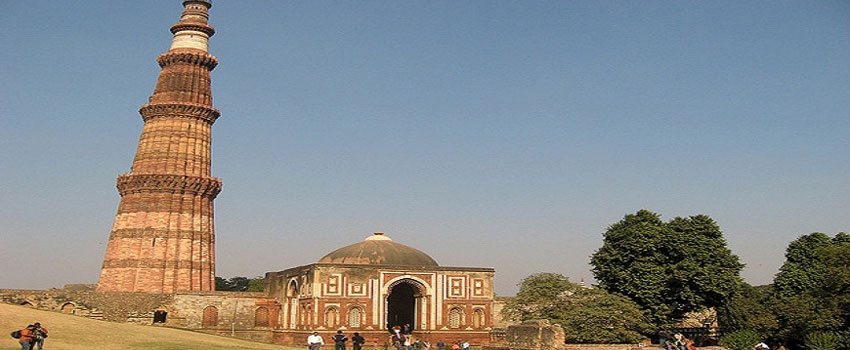
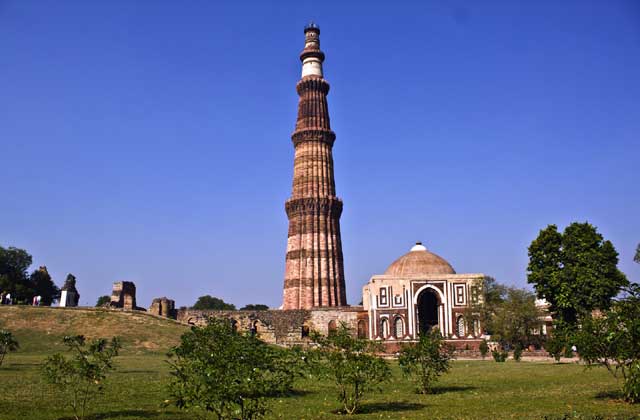
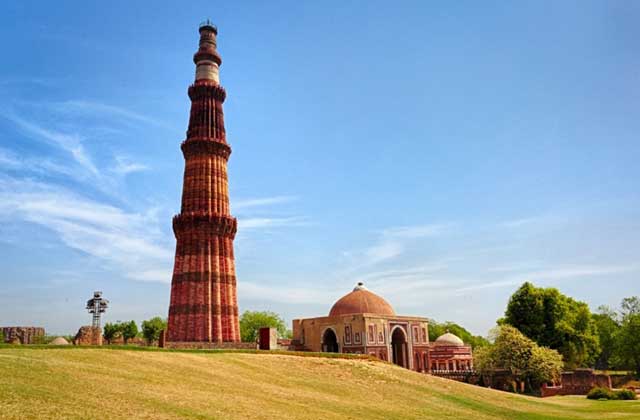
Qutab Minar, the 239ft sandstone tower is an Indo-Islamic architectural wonder of ancient India. This magnificent tower of victory stands in the Qutab Complex located at Aurabindo Marg, near Mehrauli, 14 Km south of Connaught place in Delhi. The world famous towering Qutub Minar, started in 1192 by Qutub-ud-din Aibak (1192-98), breathes down the neck of the Quwwat-ul-Islam mosque. There is a slight difference of opinion as to its purpose: it probably was a tower of victory, but then again it could have been built to be a minar (tower), attached to the Quwwat-ul-Islam mosque, for the muezzin (priest) to climb up top for a prayer.


History of Qutab Minar


Qutb-u'd-Din Aibak laid the foundation of Qutab Minar in AD 1199. The minar was said to have been built to celebrate the victory of Mohammed Ghori, the invader from Afghanistan, over the Rajputs in 1192. He raised the first storey, to which were added three more storeys by his successor and son-in-law, Shamsu'd-Din IItutmish (AD 1211-36). All the storeys are surrounded by a projected balcony encircling the Minar and supported by stone brackets, which are decorated with honeycomb design, more conspicuously in the first storey.

Numerous inscriptions in Arabic and Nagari characters in different places of the Minar reveal the history of Qutb. According to the inscriptions on its surface it was repaired by Firoz Shah Tughlaq (AD 1351-88) and Sikandar Lodi (AD 1489-1517).
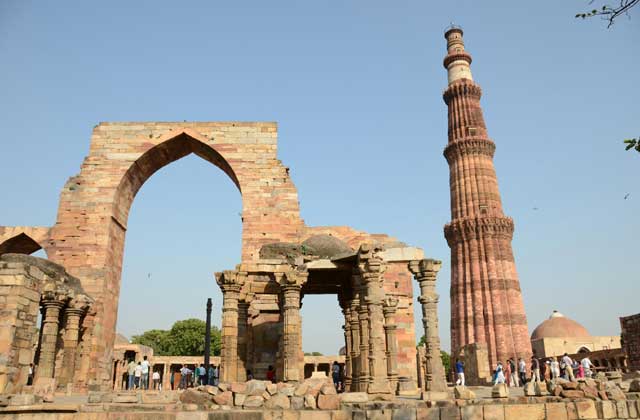
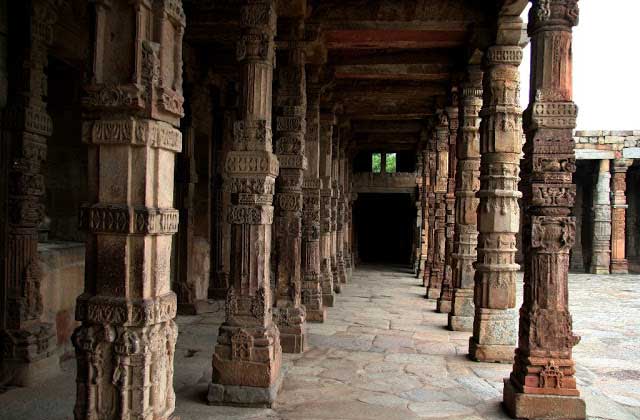
Quwwat-ul-Islam Mosque, to the northeast of Minar was built by Qutbu'd-Din Aibak in AD 1198. It is the earliest mosque built by the Delhi Sultans. It consists of a rectangular courtyard enclosed by cloisters, erected with the carved columns and architectural members of 27 Hindu and Jain temples, which were demolished by Qutbu'd-Din Aibak as recorded in his inscription on the main eastern entrance.

Later, a lofty arched screen was erected and the mosque was enlarged, by Shamsu'd- Din IItutmish (AD 1210-35) and Alau'd-Din Khalji. The Iron Pillar in the courtyard bears an inscription in Sanskrit in Brahmi script of 4th century AD, according to which the pillar was set up as a Vishnudhvaja (standard of Lord Vishnu) on the hill known as Vishnupada in memory of a mighty king named Chandra. A deep socket on the top of the ornate capital indicates that probably an image of Garuda was fixed into it.

The Tomb of IItutmish (AD 1211-36) was built in AD 1235. It is a plain square chamber of red sandstone, profusely carved with inscriptions, geometrical and arabesque patterns in Saracenic tradition on the entrances and the whole of interior. Some of the motifs viz., the wheel, tassel, etc., are reminiscent of Hindu designs. Ala 'i- Darwaza, the southern gateway of the Quwwat-ul-Islam mosque was constructed by Alau'd-Din Khalji in AH 710 (AD 1311) as recorded in the inscriptions engraved on it. This is the first building employing Islamic principles of construction and ornamentation.

Alau'd-Din Khalji commenced Ala'i Minar, which stands to the north of Kutub-Minar, with the intention of making it twice the size of earlier Minar. He could complete only the first storey, which now has an extant height of 25 m. The other remains in the Qutab complex comprise Madrasa, graves, tombs, mosque and architectural members.


Architecture


The word 'Qutab Minar' means 'axis minaret'. The tower which dominates the countryside for miles around has five storeys, each marked by a projecting balcony. The tower was built in three stages. Qutab-ud-Din completed the first storey. Second, third and the fourth were completed by his successor and son-in -law, Illtutmish in 1230. The minar was first struck by lightening in AD 1368 and the fallen top storey was replaced by two storeys's, the fourth and the fifth in 1370 AD by Feroz Shah Tughlaq (AD 1351-88).

Qutab Minar with a height of 72.5m (239ft), is the highest stone tower in India and has a diametre of 14.32 metres at the base and about 2.75 metres at the top.
The first three storeys are made of red sandstone and are heavily indented with different styles of fluting, alternately round and angular on the bottom floor, round on the second and angular on the third. The fourth and fifth floors are made of marble and sandstone.

The decoration of the Qutab Minar is consistently Islamic in character from base to top; though the somewhat hybrid style of Firoz Shah's later additions is noticeably distinct. Numerous inscriptions in Arabic and Nagari characters are seen as wide encircling bands in the plain fluted masonry of the Minar. This inscriptions reveal the history of Qutub, from its commencement in AD1199 to its repairs in between.. There is a door on the northern side, leading inside the tower to a spiral stairway with 379 steps that winds its way up to the balcony in each floor and culminating in a platform at the top. The intricate balconies held together by stalactite vaulting technique and patterned with honey combing is a special feature of the minar.

The minar has survived a series of lightening bolts and earthquakes during the past centuries. After the first lighting strike way back in AD1368 knocking off the top storey and two floors replaced instead, by Firoz Shah Tuglaq, inscriptions indicate that further repairs were done by Sultan Sikander Lodi in 1503. Later in 1803, the cupola on the top was thrown down and the whole pillar was seriously injured by an earthquake. It was repaired by Major R. Smith of the Royal Engineers who restored the Qutub Minar in 1829 replacing the cupola with a Bengal style chhattri. The chhattri was removed in 1848, by the Viceroy Lord Hardinge as it was criticized as not keeping in with the architectural style of the rest of the minar. Now it stands to the left of the entry path and is known as Smith's folly.


Visitor Medical Insurance |  Indian Insurance |  About Us |  Contact Us |  Sitemap |  Disclaimer |


Copyright NRI Online Pvt Ltd All rights reserved worldwide