NRIOL  -  Non-Resident Indians Online! Insurance - Frequently Asked Questions Visitor Medical Insurance
Indian Parents Home Parent Resources About India Indian Culture Miscellaneous About Us


Indian Symbols


National Emblem:


The Emblem of India is an adaptation from the Sarnath Lion Capital of Ashoka. Emperor Ashoka the Great, erected the capital to mark the spot where Gautama Buddha first taught the Dharma, and where the Buddhist Sangha was founded. In the original, there are four lions, standing back to back, mounted on an abacus with a frieze carrying sculptures in high relief of an elephant, a galloping horse, a bull and a lion separated by intervening wheels over a bell-shaped lotus. Carved out of a single block of polished sandstone, the capital is crowned by the Wheel of the Law (Dharmacakra).
It has four "Indian Lions", resting on a circular abacus. The fourth lion is on the rear and hence hidden from view. The emblem symbolizes power, courage and confidence. The abacus is girded by four smaller animals - guardians of the four directions: the Lion of the north, the Elephant of the east, the bull of the south and the Horse of the west. The abacus rests on a nelumbo nucifera in full bloom, exemplifying the fountainhead of life.

National Flag:


The Indian flag was designed as a symbol of freedom. The flag is a horizontal tricolor in equal proportion of deep saffron on the top, white in the middle and dark green at the bottom. The ratio of the width to the length of the flag is 2:3.In the centre of the white band, there is a wheel in navy blue to indicate the Dharma Chakra, the wheel of law in the Sarnath Lion Capital.
Its diameter approximates the width of the white band and it has 24 spokes. The saffron stands for courage, sacrifice and the spirit of renunciation; the white, for purity and truth; and the green for faith and fertility.

The late Prime Minister Nehru called it "a flag not only of freedom for ourselves, but a symbol of freedom to all people."

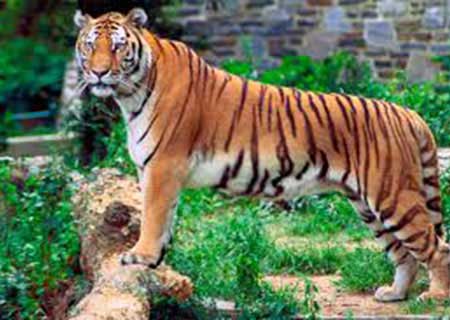
National Animal - Tiger:


Tiger (Panthera Tigris, Linnaeus) is the national animal of India. Tiger is also called the lord of Jungles. As the national animal of India, tiger symbolizes India's wildlife wealth. The rare combination of grace, strength, agility and enormous power has earned the tiger great respect and high esteem. India is home to nearly half of the total population of tigers. The government of India launched the Project Tiger in 1973 to protect the royal animal.

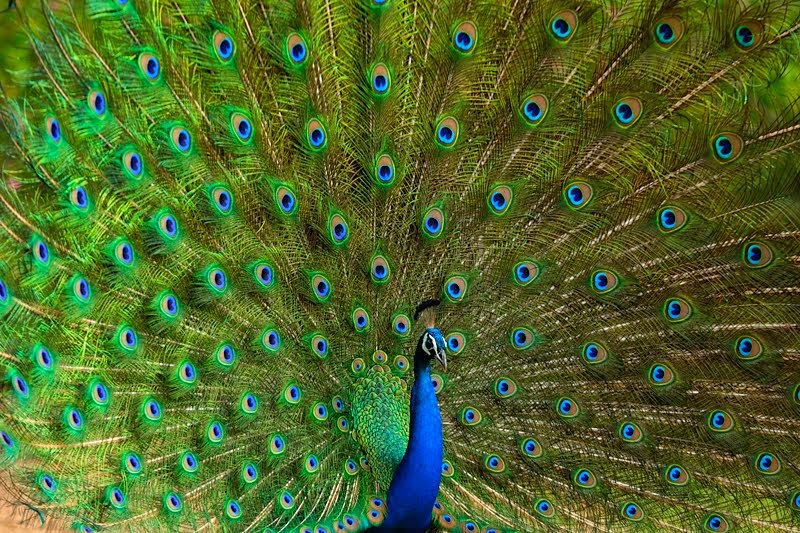
National Bird - Peacock:


The male bird of species Pavo cristatus, the peacock is a native of India, with striking plumage and upper tail converts marked with iridescent ocelli, and able to expand its tail erect like fan as ostentatious display. Peacocks are related to pheasants. It is a colorful, swan-sized bird, with a fan-shaped crest of feathers, a white patch under the eye and a long, slender neck. The male of the species is more colorful than the female, with a glistening blue breast and neck and a spectacular bronze-green train of around 200 elongated feathers. The female is brownish, slightly smaller than the male, and lacks the train.

The elaborate courtship dance of the male, fanning out the tail and preening its feathers, is a gorgeous sight. They were once bred for food but now hunting of peacocks is banned in India. The Peacock enjoys protection from the people as it is never molested for religious and sentimental reasons. It is fully protected under the Indian Wildlife (Protection) Act, 1972.

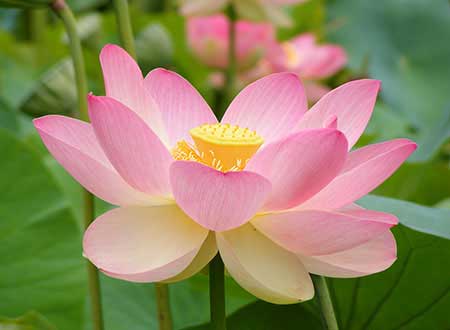
National Flower - Lotus:


The Lotus or waterlily is an aquatic plant of Nymphaea with broad floating leaves and bright fragrant flowers that grow only in shallow waters. The leaves and flowers float and have long stems that contain air spaces. The big attractive flowers have many petals overlapping in a symmetrical pattern. The root functions are carried out by rhizomes that fan out horizontally through the mud below the water. Lotuses, prized for their serene beauty, are delightful to behold as their blossoms open on the surface of a pond. In India the sacred lotus is legendary and much folklore and religious mythology is woven around it

National Tree - Banyan:


Indian national tree is the fig tree, Ficus bengalensis, whose branches root themselves like new trees over a large area.

The roots give rise to more trunks and branches. Because of this characteristic and its longevity, this tree is considered immortal and is an integral part of the myths and legends of India.

Even today, the banyan tree is the focal point of village life and the village council in most areas meets under the shade of this tree.

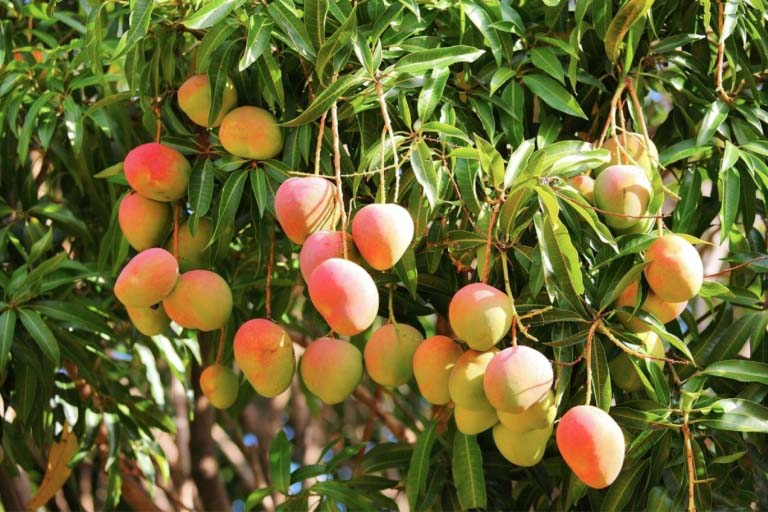
National Fruit - Mango:


The fruit Mango is regarded as the National Fruit of India. The fruit Mango is one of the most widely cultivated fruits of the tropical world. This juicy, delicious fruit is a rich source of Vitamins A, C and D. In India there are hundreds of varieties of mangoes, in different sizes, shapes and colours etc. The famous Indian poet Kalidasa sang its praises.King Alexander relished its taste, as did the Chinese traveller Hieun Tsang. Akbar, the Moghal emperor planted over 100,000 mango trees in Darbhanga, known as Lakhi Bagh(India).


Please visit our popular pages :


Indian Languages | Indian Tourism | Indian Monuments | Indian Temples


Visitor Medical Insurance |  Indian Insurance |  About Us |  Contact Us |  Sitemap |  Disclaimer |


Copyright NRI Online Pvt Ltd All rights reserved worldwide