|
|
| |
 |
Kho-Kho ranks as one of the most popular traditional sports in
India. The origin of Kho-Kho is difficult to trace, but many historians believe,
that it is a modified form of 'Run Chase', which in its simplest form involves
chasing and touching a person. With its origins in Maharashtra, Kho-Kho in
ancient times, was played on 'raths' or chariots, and was known as
Rathera. |
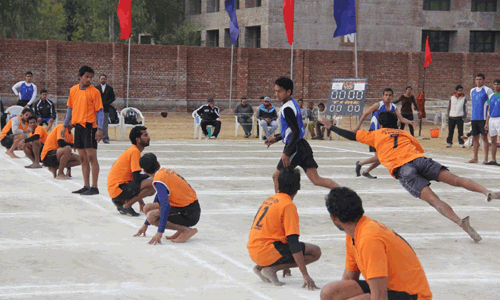
Like all Indian
games, it is simple, inexpensive and enjoyable. It does, however, demand
physical fitness, strength, speed and stamina, and a certain amount of ability.
Dodging, feinting and bursts of controlled speed make this game quite thrilling.
To catch by pursuit - to chase, rather than just run - is the capstone of
Kho-Kho.The game develops qualities such as obedience, discipline,
sportsmanship, and loyalty between team members.
The rules of the game were
framed in the beginning of the 20th century. At Gymkhana Poona, a Committee was
formed in 1914, to frame its rules. The first ever rules on Kho-Kho were
published from Gymkhana Baroda, in 1924. In 1959-60, the first national Kho-Kho
championship was organised in Vijayawada (Andhra Pradesh). The Government has
initiated the following awards for the game: Arjuna Award, Eklavya Award for
men, Rani Laxmi Bai award for women, Veer Abhimanyu award for boys under 18, and
Janaki award for girls under 16.

How the game is played
Each team consists of twelve players,
but only nine players take the field for a contest. A match consists of two
innings. An innings consists of chasing and running turns of 7 minutes each.
Eight members of the chasing team sit in their eight squares on the central
lane, alternately facing the opposite direction, while the ninth member is an
active chaser, and stands at either of the posts, ready to begin the pursuit.
Members of the chasing team have to put their opponent out, touching them with
their palms, but without committing a foul. All the action in Kho-Kho is
provided by the defenders, who try to play out the 7 minutes time, and the
chasers who try to dismiss them. A defender can be dismissed in three ways: 1)
if he is touched by an active chaser with his palm without committing a foul, 2)
if he goes out of the limits on his own, 3) if he enters the limit late.
Defenders enter the limit, in batches of
three. After the third and last defender of batch is out, the next batch must
enter the limits, before a 'kho' is given by the successful active chaser.
Defenders have full freedom of movement on both sides of the central lane, but
the active chaser cannot change the direction to which he is committed. He
cannot cross the central lane. An active chaser can change position with a
seated chaser, by touching him from behind by palm, and uttering the word 'kho'
loudly, and simultaneously, chase or attack is build up through a series of
'khos' as the chase continues with a relay of chasers.
At the end of the innings there is an
interval of 5 minutes and an interval of 2 minutes, in between the turns. Each
side alternates between chasing and defence.
Kho-Kho can be played by men, women, and
children of all ages. The game requires a very small piece of evenly surfaced
ground, rectangular in shape, and 27m by 15m. The only equipment required are
the two poles. The game lasts no more than 37 minutes.
Domestic seasons and tournaments
The following
championships are organised for this game:
National
Championships, Junior National, Sub Junior National Championship, School
Championship, Mini School Championship, Primary Mini School Championship,
National Women Championship, All India Inter University Championship and
Federation Cup
Organisations involved with the sport
in India
The primary sports
body for this game is called the Kho-Kho Federation of India (K.K.F.I.). It has
its branches in all the states and it has been conducting Mini, Junior and Open
National Championships for both sexes, in many parts of India.
|
|
|
|
|