108 Names of Lord Rama
108 Names of Lord Hanuman
108 Names of Lord Muruga
108 Names of Lord Vigneshwara
108 Names of Lord Ayyappa
108 Names of Lord Sathyanarayana
108 Names of Lord Venkatesha
108 Names of Lord lakshmi Narasimha
108 Names of Goddess Lakshmi
108 Names of Goddess Saraswathi
108 Names of Goddess Durga
108 Names of Goddess Annapoorni
108 Names of Goddess Andal
Slokas - Lord Ganapathi
Slokas - Lord Shiva
Slokas - Lord Murugan
Suprabhatam
Indian Game: Pachisi
Pachisi (also spelt Parcheesi, Pachisi, Parchisi, Parchesi; also known as Twenty-Five) is the National Game of India. The name comes from the Indian word "pacis" which means twenty five, the highest score that could be thrown with the cowry shells. Pachisi is, in fact, the younger sister of Chaupar (or Chausar or Chaupad, also known as Pat in Sanskrit), a more venerable, complex and skilful game that is still played in India.
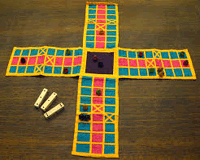
The Indian Emperor Akbar I of the 16th century Mogul Empire, apparently played Chaupar on great courts constructed of inlaid marble. He would sit on a Dias four feet high in the centre of the court and throw the cowry shells. On the red and white squares around him, 16 beautiful women from the harem, appropriately coloured, would move around according to his directions. Remains of these boards can be seen today in Agra and Allahabad.
There is apparently a mention of Chaupar being played between two sets of princes - cousin brothers of the Bharata family (Pandavas and Kauravas) in the epic, Mahabharata. During this game the righteous Padavas lost the game and their entire fortune to the devious Kauravas, which put his family through a lot of hardship and suffering. This was ended by a great war among them which led to destruction of the Kauravas. It is since that time that the play of this intelligent game has dwindled due to a superstition that it leads to pain and suffering... [Thanks to Mayuresh Kathe for this note].
The origins of Pachisi and Chaupar are lost in time but uncertain evidence indicates that forms of the game were in existence in the Indian region from at least the 4th century AD.
Both have hardly changed since Emperor Akbar played although the game is not as widely played in India as it once was. Pachisi boards are typically constructed of cloth, 6 cowry shells are thrown to determine the moves and the counters are made of wood in a beehive shape.
There is apparently a mention of Chaupar being played between two sets of princes - cousin brothers of the Bharata family (Pandavas and Kauravas) in the epic, Mahabharata. During this game the righteous Padavas lost the game and their entire fortune to the devious Kauravas, which put his family through a lot of hardship and suffering. This was ended by a great war among them which led to destruction of the Kauravas. It is since that time that the play of this intelligent game has dwindled due to a superstition that it leads to pain and suffering... [Thanks to Mayuresh Kathe for this note].
The origins of Pachisi and Chaupar are lost in time but uncertain evidence indicates that forms of the game were in existence in the Indian region from at least the 4th century AD.
Both have hardly changed since Emperor Akbar played although the game is not as widely played in India as it once was. Pachisi boards are typically constructed of cloth, 6 cowry shells are thrown to determine the moves and the counters are made of wood in a beehive shape.
