Indian Game: Mallakhamb
Mallakhamb is an ancient traditional Indian sport. 'Malla' means gymnast, and 'khamb' means pole. Thus, the name 'Mallakhamb' stands for 'a gymnast's pole'. The origin of Mallakhamb can be traced to the 12th century, where it is mentioned in Manas-Olhas - a classic by Chalukya in 1135 A.D. For seven centuries, the art lay dormant, till it was revived by Balambhatta Dada Deodhar, the sports and fitness instructor to Peshwa Bajirao II, who reigned during the first half of the 19th century. The apparently simple 'khamb' does not reveal the complexities of the exercises, which require the performer to turn, twist, stretch and balance on the pole. It is this consummate grace, this agility, dexterity and suppleness of body, combined with quick reflexes, muscle coordination and sense of timing, that single out this game as special. Of the states in India, more than 14 participate in Mallakhamb competitions at the national level.
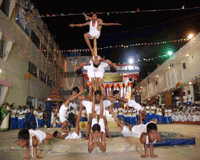
At present, the following forms of Mallakhamb are prevalent
Plain Mallakhamb - fixed on the groundIn this, a vertical wooden pole is fixed in the ground. The wood used is usually teakwood or sheeshum, preferred because of its twin characteristics of toughness and smoothness. The pole stands 225 cm above ground level. It has a circumference of 55 cm at its lower end, 45 cm in the middle, and 30 cm at the upper end. The height of the neck is 20 cm, and its circumference is 15 cm, and radius of the upper knobe is 13 cm.
Hanging Mallakhamb
A smaller version of the fixed Mallakhamb, it is suspended with the aid of hooks and chains. The swinging and revolving motion of this type of Mallakhamb renders the exercises quite difficult and exacting.
Cane or Rope Mallakhamb
Here, a cotton rope which is 2.5 cm thick, replaces the wooden pole. The performers are expected to strike various yogic poses, without knotting the rope in any way.
Revolving Bottle Mallakhamb
This is a recent innovation, and consists of 32 glass bottles placed on a wooden platform, with the Mallakhamb balanced on top.
The other forms of this sport include the Baseless Mallakhamb and Fixed Bottle Mallakhamb. Recently, a few more variations have been introduced, viz. Inclined and Suspended Mallakhamb.
Mallakhamb exercises make the body light and strong. These exercises are most beneficial for the stomach, back, arms and thighs, and have been found useful to achieve efficiency in a number of other games and sports like gymnastics and wrestling. The Mallakhamb sport affects the spinal chord most, which develops energy and increases longevity, and is the only exercise in which all big and small organs of the body are active.
