Khajuraho Temple
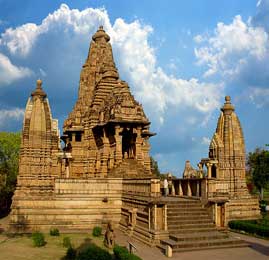
The history of this temple has many stories, during those days this was the very small town with many old temples and many dangerous animals roaming around.
The unique style of carvings and architecture has attracted many visitors all-round the world, but the purpose of this style is how their thinking capacity works towards the temple architecture. The visitors rushing towards the temples have many queries like temple significance, importance and mainly this temple has a greater impact on the individual. The reason behind why the visitors are found large in number because it has a beautiful style, it has an art museum, many small temples, and there is no destruction of any carvings around the temple.
The unique style of carvings and architecture has attracted many visitors all-round the world, but the purpose of this style is how their thinking capacity works towards the temple architecture. The visitors rushing towards the temples have many queries like temple significance, importance and mainly this temple has a greater impact on the individual. The reason behind why the visitors are found large in number because it has a beautiful style, it has an art museum, many small temples, and there is no destruction of any carvings around the temple.
According to the earlier days this is called as Khajur-vahika' or 'Khajjurpura' because of its golden date palms that was found large in the city. The history of Mahoba-khand tells that there was the poet called Chandbardai's mentioned like there was a royal priest Hemraj from Kashi had a daughter called Hemvati, who is a child widow. As she was very beautiful Moon God got impressed by her while she was in the lotus lake, he came to earth in the human form and ravished her, and after few days he was cursed by the Hemvati for spoiling her life and also Hemvati was blessed with a son, later is the king and the person who will build Khajuraho temples.
The days went on Hemvati gave birth to Chandravarman, is a very brave boy of 16years old who has a dare to kill lions and tigers with his hands. Later with the blessings of his parents he built the fort at Kalinjar and 85 temples and these temples are built around the lakes and gardens. He performed bhandya yagya to get rid of his mother sins. Mani Ram, the royal priest of Kalinjar temple, due to some miscalculation in his mind he told the dark night as the full moon night in the kingdom.
One fine day Mani Ram came to know about the whole story and turned himself to a stone. Again, Hemvati got pregnant and gave birth to Chandrateya who is the founder of the Chandela dynasty.
The days went on Hemvati gave birth to Chandravarman, is a very brave boy of 16years old who has a dare to kill lions and tigers with his hands. Later with the blessings of his parents he built the fort at Kalinjar and 85 temples and these temples are built around the lakes and gardens. He performed bhandya yagya to get rid of his mother sins. Mani Ram, the royal priest of Kalinjar temple, due to some miscalculation in his mind he told the dark night as the full moon night in the kingdom.
One fine day Mani Ram came to know about the whole story and turned himself to a stone. Again, Hemvati got pregnant and gave birth to Chandrateya who is the founder of the Chandela dynasty.
About Khajuraho Temple
Khajuraho, is the temple where the entire architecture is full of stone carvings and pillars. Many visitors are attracted towards this temple because it will uphold the Hindu culture. Khajuraho has a history of the kingdom, ruled by the Rajput kings over Central India and later became the small village with many temples.| Location | Madhya Pradesh. |
| Famous for | Erotic sculptures. |
| Languages | Hindi, English, Marathi. |
| Completed in | Between 950 and 1050 A.D. |
