| |
Hampi, "the city of ruins" or "the city of Open Sky" was the capital of the Vijayanagara Empire. Vijaynagara was one of the largest Hindu empires in India and is one of the most fascinating historical places in South India. Hampi is just around 13 kms from Hospet. The "Hampi Utsav", or the festival of Hampi is celebrated in the month of December.
History of the temple
Two brothers Hakkaraya (Hakka) and Bukkaraya (Bukka) laid a foundation to the new empire in the south which was called "Vijayanagara Empire" under the guidance of a Brahmin priest Vidyaranya of Sringeri in 1336 AD. The three dynasties namely Sangamas Suluvas and Tulvas ruled the Vijayanagara Empire for over many decades before they were defeated badly by the Mughal rulers. The capital city of Vijayanagara empire Hampi was looted and destroyed by the muslim rulers The reign of Tulivas is described as the golden age of the empire which saw two eminent rulers Deva Raya and Krishnadeva Raya. The name and fame of the kingdom reached its zenith during their period. The kingdom was extended from the Arabian Sea to the Bay of Bengal and from the Deccan Plateau to the tip of the southern peninsula.
An ideally located location, Hampi is naturally fortified by the steep Rocky Mountains with massive boulders of granite in three directions and the mighty river Thungabadhadra in the other direction. It was therefore the obvious choice as the capital of the kingdom. Hampi was not only selected for its location but also for its huge raw material store for buildings.
Art and Architecture
The emperors of this dynasty were great patrons of art and architecture. They built temples and monuments in Dravidian Style and Nagara Style. Some of the architectures also include a combination of Chalukya, Hoysala and Dravida styles. Hampi is surrounded by many temples. You can find temples built by the Vijayanagara rulers up to a stretch of a nearby town Kamalapur which is 3kms away from the capital town. The Hampi Bazar which was known for its sale of pearl, coral, gold and many ornaments is stretched from Virupakasha temple to the foot of Matanga Hills opposite to the temple.
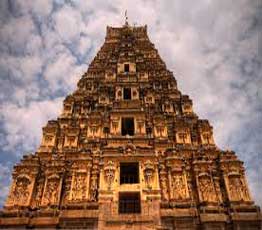
One among the main temple attractions of Hampi is the Virupaksha Temple which is the oldest of the temples in Hampi. It was constructed in the 15th century, has 12 storeys and is 50 meters tall. The temples of Hampi are famous for their large dimensions, florid ornamentation, both in painting and carving, majestic pillars, magnificent pavilions and a great wealth of religious and mythological depictions, including subjects from the Ramayana and the Mahabharata.
Vijaya Vittala temple is the most splendid of temples at Hampi which was constructed by Krishnadeva Raya. It is considered to be the most decorated temples of the Vijayanagar kingdom. Vittala is an incarnation of Vishnu. This temple has 56 ornate monolithic pillars which have world class architecture because getting musical notes from the columns require great accuracy. Each pillar is surrounded by stone columns. On striking these columns gently, we can hear different musical notes. . The temple stands over a large rectangular enclosure. The main temple occupies the centre and compromises three distinct sections-Maha Mantapa, Ardhamantapa, Garbhagriha. The Stone Chariot, a heavy stone car with movable wheels is the other specialties of the temple. The temple has variety of styles that is characterized in the shrines within the temple courtyard.
Hazara Ramaswami Temple is believed to have been the private place of worship of the royal family. The walls and pillars of the temple are beautifully adorned illustrating the chief episodes of the Ramayana. The outer walls depict images of god, goddesses and the social life of the people of Vijayanagara kingdom, horses, elephants, dancing girls and infantry in procession
Mahanavami Dibba is 10 feet beautifully covered single rock for royalty view. The kings of Vijayanagar used to sit on a grand throne in the House of Victory and witness the nine-day Dasara festival. Sasivikalu Ganesha or the Mustard Ganesha is curved magnificently from a single rock of 9 ft tall, Ugara Narasimha is a 22 ft high single stone statue with an incarnation of half like a man and half like a lion seated in a canopy of seven headed snake is world class. Kadalae Kalu Ganesha or Peanut Ganesha is an 18 ft high single stone statue
Lotus Mahal a two storied Lotus Mahal has a combination of Hindu-Muslim architecture which is different from other Hampi temples. The base of the mahal is an open archway. The building gets its name due to its geometrically well placed carved archways which resembles petals of the flower seen from the top. . It was an air-cooled summer palace of the queen. Elephant Stables is another good example for Hindu-Muslim architecture is the Elephant Stables popularly known as "Aane Saalu" which housed as many as 11 elephants in separate compartments.
Queen's Bath, the architecture and engineering skill is the most splendid work. The Queen’s bath house is a square structure with beautiful interior carvings, arched corridors, projected balconies and lotus shaped fountains. This has a Muslim style of architecture.
|