|
|
| |
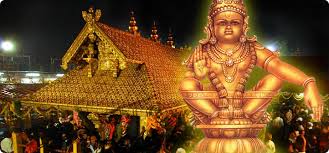
The best known pilgrimage destination in Kerala is Sabarimala's Ayyapan temple. High up in the Sahyadri Mountains (Western Ghats), the Ayyapan Temple deity is an alloy of five metals, and is about one and a half feet tall. Ayyappan is also known as Bhuthanatha, Dharmasastha, Hariharan and Ayyanar. A pilgrimage to this temple symbolizes the journey to heaven. The male pilgrims are called "Ayyappans" and female pilgrims are called "Malikappuram". The pilgrimage begins in the month of November and ends in January. The temple stays closed during the rest of the year except for the first five days of every Malayalam month and during Vishu (April). The temple is open for all age groups for males and for women after the age of 50 and girls below the age of 10 years. Pampa is the main halting point on the way to Sabarimala. From here one has to trek 4 to 5 kms to reach the temple.
Other temples include shrines of Kannimel, Ganapathy, Nagara, Karuppa Swamy, and Malikappurathamma. Once in a year, during Makara Sankranthi, the Raja visits Sabarimala along with the holy ornaments from the Palace, which are, adorned on the Ayyappa deity and 'Deeparadhana' conducted. It is at this time that the 'Jyothi' appears on the eastern horizon.
History of the temple
Legend has it that there once lived a king Rajasekara of Pandalam. He had no offsprings to occupy the throne after him. He conducted many rituals and poojas to get an offspring but to no avail. Once when he went hunting in the forest near the pampas, he found a new born child left unattended. As the king had no offsprings, he bought the new born child to the kingdom. Since the baby had a "Mani" in the neck, he was named as Manikanta.
The story behind his birth is that Mahishi, a demon had a boon from Lord Brahma that she should get death from a child born by the union of Hari (Lord Shiva) and Hara (Lord Vishnu) and not from any others. With this boon Mahishi came to be known as Mahishasura, a demon with a buffalo face. As she wanted to revenge her brothers death by the gods, she went to heaven troubling all the heavenly deities and destroyed all yagnas and poojas conducted by rishis. When her evil deeds went out of control, Lord Narada sent a message to Manikanta who fought with the demon and killed her.
After finding out the reason for Manikanta's coming down to earth, the king felt very sad as he wanted to make Manikanta the king of the Pandalam. Then Manikanta took the king to the Sahyadri hills and asked him to build a temple with 18 steps. He also told his father to decorate his idol with ornaments on the day of sankranthi and he would give darshan to the king and to every body as “Makara Jyothi”
One more legend says that Sage Parasuram retrieved Kerala from the sea by throwing his axe, installed the idol of Ayyappa at Sabarimala to worship Lord Ayyappa
Pilgrimage to Sabarimala
There are certain rules and regulations for Sabarimala pilgrims. A person who wants to put a "maala" first has to get permission from the guruswamy. After taking bath, he places photo or idol of swami Ayyapa on a raised platform with 18 steps decorated with flowers. He performs pooja first to the Ganapathi idol and Ayyappa idol and the holy maala and receives the maala from the guru. The devotee should also buy a new pair of coloured dhoti and towel or shawl. The devotee should walk barefoot, lead a bachelor life and should have vegetarian food. He should spend time praying to the Lord and should avoid all types of worldly pleasures.
The Guruswamy is the one who has undertaken pilgrimage to Sabarimala not less than seven consecutive years and has had the darshan of Makara Jothi. He will guide them to perform poojas, bhajans and will lead them to pilgrimage to Sabarimala
While taking pilgrimage he carries lrumudi on his head, the only language with him.
Those who carry this Irumadi are allowed to climb on the 18 steps. These 18 steps symbolize "Bhoomi, Agni, Vayoo, Aakash, Karma, Znana, Intelligence and Jeevatma". Those who cross all these steps achieve "punyadarshan". One needs to have the sacred Irumudi on head while going up or down the 18 steps.
|
|
|
|
|