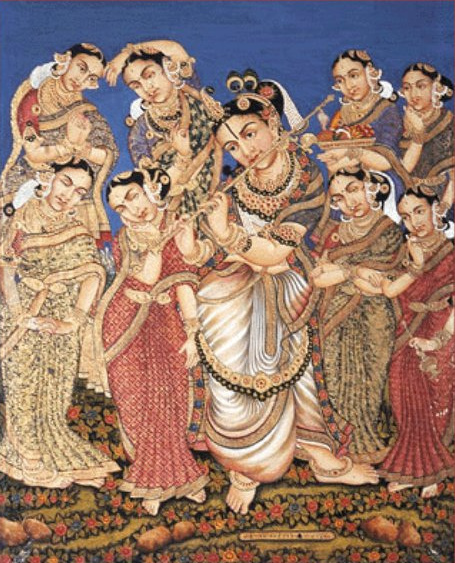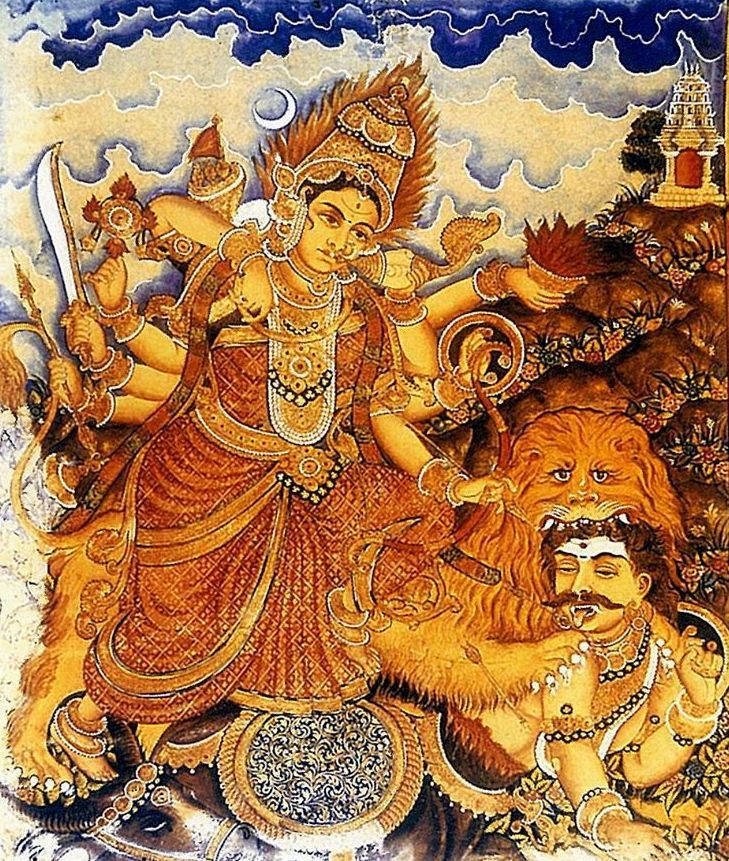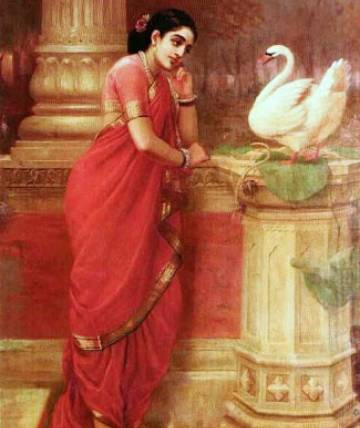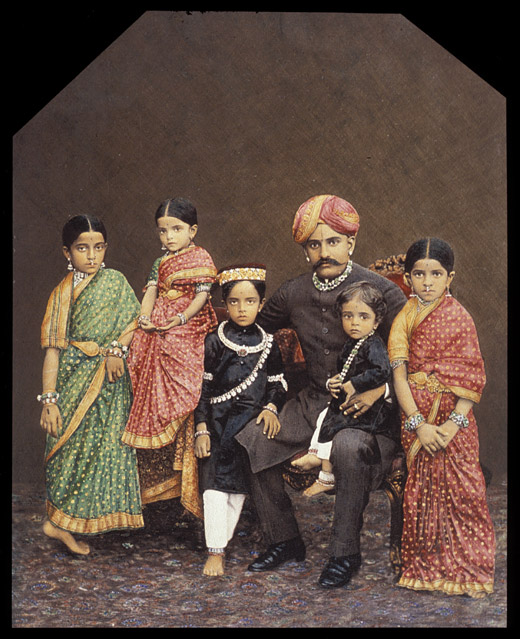
Mysore Paintings


Paintings from Mysore

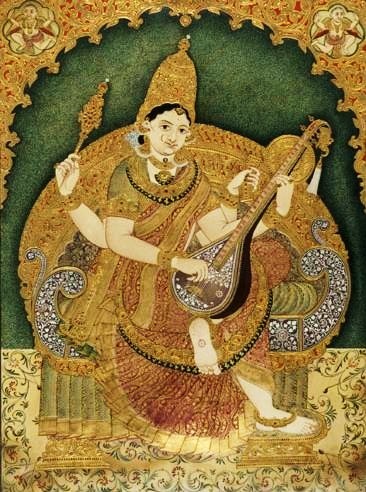
The ancient Indian culture had always made aninteresting reading, as it had something significantto contribute in the field of human value system. Artis an integral part of culture. Therefore the study ofart in the backdrop of our ancient culture makes itnot only interesting but also in the process add richvalue to our learning. Under this context a study ofMysore Paintings, a rich traditional art form of SouthIndia enables us to understand the rich culturalvalues of our past.

The state of Mysore (now called Karnataka) has aunique distinction of pioneering an attractive form ofart during 17th and 18th centuries, which later becamecommonly known as the Mysore School. Historically,Mysore had been a place governed by many a rulers whohad a strong passion for visual arts, which includedarchitecture and painting. The intricate work whichhas been done on several of the temples, palaces andforts in Mysore stands testimony to the architecturaland sculpting capabilities of the craft persons ofMysore in the earlier days.

Raja Woodeyar(1578-1617 AD) is traced to have madesome significant contribution to the cause of artistsin the different parts of the erstwhile state ofMysore. He had even built two temples, one atSrirangapatna and the other at Ganjam for NimishambaDevi, a deity worshipped by the artist community.Artists during this period were engaged in differentforms of art which included decorative works intemples, painting temple cars and walls, making templebanners, painting portraits of rulers, saints anddeities. It was during the reign of MummadiKrishnaraja Woodeyar(after the death of Tippu Sultanin 1799 AD), Mysore witnessed a major fillip in thefield of visual arts. The paintings during his periodhad a variety - murals depicting several scenes ofHindu mythology, portraits of heroes and kings, iconsof Hindu mythology, strictly adhering to theiconography principles. These paintings found itsplace in temples, palaces, community buildings andhouses belonging to royalty and rich merchants.


In the traditional Mysore paintings, the artists usedto prepare all the input materials required forexecuting the painting. This would include brushes,paints, board, gold foil etc. Artists used vegetableand mineral colours made out of pigments of leaves andflowers of various plants and minerals. Today thepainting is done with commercially available medialike poster and water colours. In the ancient times,paper, wood, wall and cloth formed the base for doingthe painting. In modern times it is done mostly onpaper pasted on to a board with glue or some otheradhesive medium.

After the preparation of the board, the requiredsketch is then made on the paper with a pencil. If atracing of the sketch is already available it is thentransferred on to the board with a carbon paper. Inthe earlier days, sketching was made with charcoalprepared by burning tamarind twigs in an iron tube.Colours made out of minerals were prepared by grindingthe minerals in a stone mortar and then put in waterto make them soft in form of a paste. Brushes weremade of different materials, which included squirrel,camel and goat hair. Sometimes grass blades were alsoused for making sharp lines. Today, commerciallyavailable water and poster colours are used withbrushes of different grade available in the market.Once the sketch is made, the gesso work is taken up onthe area ear marked. Gesso work is normally done whereembellishments are to be made. Design work is carriedout on the mandapams, the jewelleries, the attireetc., with a specially prepared compound and a brush.On the completion of the work, after the compounddries, gold foils are placed over them and stuckfirmly. Painting is subsequently done. After thepainting is completed and it dries, a thin paper isplaced on top of it and rubbed softly with a smoothsoft stone to bring the richness in the relief workdone with gold foil.

Though the Mysore School is an art form bearingstriking resemblance to the Mysore School, it may benoted that there are distinct differences in thestyle. While the Mysore School gives much ofprominence to the relief work done with gold foil andembellishments with decorative stones, the Mysoreschool underplays the relief work. The Mysore Schooldoes not use stones, and the relief work is subtler.

The foil work is more delicate. In the Mysore schoolextensive use of primary colours are made, viz. green,red and blue. In the case of Mysore paintings , theartist has the flexibility to use a wider spectrum ofcolours and need not necessarily restrict the paintingto the deep primary colours. Besides in thetraditional Mysore School the colours are more flat,while in the Mysore school the use of light and shadeeffect is more predominant.

While it is apparent that during the last two decadesa lot of work has been done to revive the MysoreSchool, the Mysore School still needs attention.Currently there are a very few artists and art groupswho are engaged in this school. It would be theendeavour of Raasi Art Foundation to revive this artthrough research, education, training and promotion.The Raasi Art Gallery houses some of the finest piecesof Mysore paintings. These works are executed bywell-trained and talented artists and art groups.

 
Interesting Information
- Visitor Insurance
- Practical Immigration Info
- Student Medical Insurance


Indian Insurance
- Health Insurance India
- Travel Insurance India
- Student Insurance India
 
Indian Festivals
 
NRI Shop
- Visitor Insurance
- Indian Tour Packages
 
Interactive NRIOL
- NRI Survey
- Letters to Editor
 
Calories Counter
 
Health Tools
- Basal Metabolic Rate
- Body mass index
- Body Fat estimator
- Waist Hip Ratio calculator
- Healthcare tips
 
 
NRIOL Community


Home | News & Views | NRIOL Exclusives | Community | Resources | India Travel Insurance | Visitor Medical Insurance | Shop | Help | Feedback
Estd. 1997 © Copyright NRI Online Pvt. Ltd. All rights reserved worldwide. Please read our site policy.