NRIOL  -  Non-Resident Indians Online! Insurance - Frequently Asked Questions NRI Insurance.  Reach  NRIs
NRIOL Home latest News & Views NRIOL Exclusives Community Resources Shop Help
 Inside NRIOL
  NEWS & VIEWS
  Live Indian News
  Live News
  Newsline
  Movies & Music
  Cricket scores
  English Newsline
  Vernacular Newsline
  More in News...
NRIOL EXCLUSIVES
  Snippets
  Featured Articles
  Columnists
  Poets Corner
  More in Exclusives...
COMMUNITY
  Overseas Students
  20 Questions
  NRI Organizations
  NRIOL Happenings
  Culinary Club
  More Community...


RESOURCES
  Int'l Movers
  Yellow Pages
  Web Directory
  Classifieds
  People Search
  Indian Baby Names
  Forex Rates
  NRI FAQs
NRIOL SHOP
  Visitors Insurance
  Visitors Travel Insurance
  Visitors Medical Insurance
  Visitors Health Insurance
  Shipping to India
  Indian Tour Packages
  Art Gallery
  Value Services
  Intl Moving
  India Travel
  Shopping Directory
  Exciting deals...

 Search - more options


 Interactive NRIOL
Discussion Forum
Opinion Poll
Events Calander
NRI Survey
Letters to Editor
 Site Information
Site Map
Search
Help Using NRIOL
Subscribe Newsletter
Refer Page
Press Releases
Awards & Accolades
Advertisement Info
About Us
Contact Us

NOSE BLEEDS - Dr.Kumaresh Krishnamoorthy Column


Dr.Kumaresh Krishnamoorthy is a NRIOL featured columnist. He pens "The Dr.Kumaresh Krishnamoorthy Column". To read about Dr.Kumaresh Krishnamoorthy , please click here.

What is a nosebleed?

A nosebleed occurs when the membranes lining the inner nose are disturbed or irritated enough to cause abnormal bleeding. The medical term for nosebleed is epistaxis. There are two types of nosebleeds: anterior and posterior. If the bleeding is near the front of the nose, it is an anterior nosebleed. Nosebleeds in children are almost always of the anterior type. Anterior nosebleeds are common in dry climates or during the winter months when the dry air parches the nasal membranes so that they crust, crack, and bleed. A posterior nosebleed occurs in the back of the nose and is not always characterized by rapid bleeding but may be slow, steady ooze. Posterior nosebleeds are more likely to occur in older people. It may be more difficult to locate the site of the damage in a posterior nosebleed than in an anterior nosebleed. An anterior nosebleed is usually not as severe or serious as a posterior nosebleed.

What causes nosebleeds?

If you have a nosebleed after a heavy blow to your skull, it could mean you have a fractured skull. You should go to the hospital immediately.

The most common causes of nosebleed are:
  • A breakdown in the membranes lining the nose. This can be triggered by poorly humidified air or probing, bumping, picking, or rubbing your nose.
  • Blowing the nose forcefully can also cause a nosebleed, especially if the nasal lining is already inflamed because of a virus, bacteria, or allergy.
  • Injury to the face or nose.
  • Scars and damage from previous nosebleeds that reopen and bleed.
  • High blood pressure
  • Medicines that slow the time normally required for the blood to clot.

Why is the nose prone to bleeding?

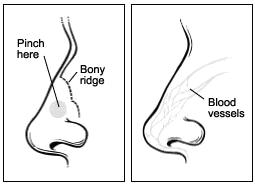
The nose has many blood vessels in it to help warm and humidify the air you breathe. These vessels lie close to the surface, making them easy to injure.

What are the symptoms of nosebleeds?

Symptoms of anterior nosebleed include intermittent or constant bleeding out of the front of the nose. Blood can flow from one or both nostrils and can flow into the throat. Symptoms of posterior nosebleed include bleeding that stops and starts, rapid bleeding from the back of the nose, or a slow, steady ooze. Sometimes the blood flows back into the throat. Especially with posterior nose bleeding, one can lose blood quickly.

How are nosebleeds treated?

Nosebleeds may be treated by first aid, packing, cauterization, surgical procedures including reconstruction of the nasal septum and arterial ligation, and embolization.

First Aid for Nosebleeds

Most common nosebleeds will stop after the application of first aid by the patient.
  • When your nose starts bleeding, sit up and lean forward to prevent blood from passing into your throat, which may cause choking.
  • Pinch the nose firmly together between the thumb and index finger, just below the nasal bones, and hold it for 10 minutes.
  • Moisten a cotton ball or pad with a saline nasal spray and press it against the bleeding part of the nose if possible.
  • If a nosebleed does not respond to first aid or lasts more than 20 minutes, it is necessary to see an ENT specialist.

Cautery

Cauterization is a procedure used to force the blood to clot (coagulate) at the site of the bleeding. Cautery may be done with silver nitrate or with an electrocautery instrument. Electrocautery is usually reserved for more severe bleeding and posterior nosebleeds, and usually requires the use of local anesthesia.

Nasal Packing

Nasal packing may be used to treat nosebleeds not responsive to cautery. Packing for anterior nosebleeds (near the front of the nose) is relatively simple. Packing for posterior nosebleeds (in the back of the nose) can be more difficult and uncomfortable. For posterior nosebleeds, rolled gauze or recently developed inflatable balloon devices may be used. If a posterior pack is placed, an anterior pack will also be used as well. Patients will receive antibiotics to prevent infection. Patients should never remove their packing; severe bleeding and improperly handled packing can be fatal.

Surgical Treatment of Nosebleeds

While most nosebleeds stop with cautery and/or packing, severe or recurrent bleeding may require surgical treatment. Procedures may include:

Endoscopic examination under general anesthesia and Septoplasty (surgical reconstruction of the nasal septum)

Packing may fail because of lack of cooperation (especially among children) or from problems such as a deviated septum. An endoscopic exam under general anesthesia may be performed, bleeding sites may be cauterized, deviated septum may be straightened, packing may be replaced, and arterial ligation may be performed during the same procedure, if necessary.

Arterial Ligation

Arterial ligation involves constricting specific blood vessels in order to stop bleeding. Procedures may require local or general anesthesia.

Embolization for Nosebleeds

Embolization entails the introduction of a substance into a blood vessel in order to close it and prevent bleeding.

How can I help prevent a nosebleed?

Some causes of nosebleeds can be prevented or managed as follows:
  • When you have a nasal infection, keep your nose well coated with a petrolatum- based ointment or an antibiotic ointment until your nose heals (usually 3 to 5 days).
  • Avoid injuring the nasal mucosa with nose-picking, rubbing, or forceful blowing.
  • Use a saline nasal spray to keep the nose moist.
  • Do not pick or blow nose (sniffing is all right).
  • Keep children's fingernails short to discourage nose picking.
  • Quit smoking. Smoking dries out your nose and also irritates it.
  • Open your mouth when you sneeze.
CONTACT:

Dr.Kumaresh Krishnamoorthy, M.S (ENT)
Head and Neck Surgery Fellowship (Buffalo, USA)
Neurotology & Skull Base Surgery Fellowship (Cincinnati, USA)
Senior Consultant in ENT - Head and Neck Surgeon and Skull Base Surgeon
Apollo Hospitals, 154/11, Bannerghatta Road, BANGALORE 560 076, INDIA

Phone: 91-(0) - 99002 36819
Email: drkumaresh@drkumaresh.com.


For the columns authored by Dr.Kumaresh Krishnamoorthy in "Dr.Kumaresh Krishnamoorthy Column", please click here.

If you would like to express your concerns, please contact us.

NRIOL Search Comprehensive search page...
NRIOL Site Map Listing of what is contained in this site
Contact NRIOL Give us your feedback or report any problems

 Indian Insurance
 Travel Insurance - Buy Online
 Student Insurance - Buy Online
 Motor Insurance - Buy Online
Visitors insurance
 Visitors Insurance
• US Health Insurance
• Immigrant Insurance
• Short Term Insurance
• Travel Insurance
• Visitors Medical Insurance
• Visitors Health Insurance
• J1 Visa Insurance
• Trip Insurance
• Global Health Insurance
• Nanny Insurance
 NRIOL Channels
• Indian Parenting
• Welcome to America
• US Immigration
• Return to India
• Welcome to Canada
• Welcome to the UK
• Indian Languages
• Traditional Indian Art
• English Language Tools
• Health Tools
• Indian diaspora
• Indian Tourism
 More NRI Links
• India Move / Return to India
• NRI Banking & Loan
• Desi DVD Rentals
• India / State Governments
• India Travel & Tourism
• NRI property FAQs
• NRI investments FAQs
• Indian consulates & embassies
• Indian grocery translations
• Customs and baggage rules
• Person of Indian Origin card
• Amazing Facts about India
• NRI Acronyms
 NRIOL Newsletter
Enter your email address below:

To Unsubscribe
 Yellow Pages
• Consulates and Embassies
• Groceries
• Indian Restaurants
• Cultural Organizations

Home | News & Views | NRIOL Exclusives | Community | Visitor Medical InsuranceIndian Insurance | Shop | Resources | Shop | Help | Feedback |
Estd. 1997 © Copyright NRI Online All rights reserved worldwide. Please read our site policy.