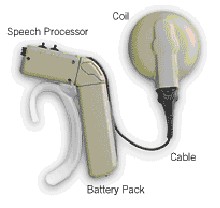
- The external components consist of the microphone, the speech processor, and the link that allows communication with the implanted parts. Also, the power supply for both, the external and the internal components, is provided by the external part.
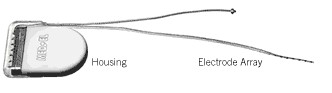
- The internal parts consist of the receiver, the stimulation electrode, and the reference electrode. The signal is received via a radiofrequency link through the intact skin. The signal is then processed and used to stimulate the main electrodes inside the cochlea in a designated pattern.
How does a Cochlear Implant work?
Contrastingly however, a cochlear implant is an excellent method of treatment and intervention for patients who have levels of hearing loss in the severe to profound range or those who can no longer benefit from traditional amplification/hearing aids. The cochlear implant is similar to a pacemaker.
First (1), the microphone gathers sound from the environment and sends it to the speech processor. The speech processor changes sound to a specially coded electrical signal.
Then (2), the message is sent along the cable and up to the headpiece (coil). The signal travels from the transmitter of the headset across the skin to the internal receiver. From the receiver, the sound moves down the electrode array to each individual electrode contact.
Electrical stimulation ("firing"), generated by the array (3), is distributed to different areas of the cochlea. Auditory nerve captures the electrical signal and sends it to the brain to be interpreted as sound & speech. In the absence of the external speech processor (i.e. removing it at night to sleep or when bathing, showering, or swimming), the patient will be unable to hear sounds or speech from the environment. The two pieces work together to provide the patient with quality hearing and speech comprehension.
The cochlear implant consists of two distinct pieces; one is an internal receiver/stimulator (surgically implanted) and the second is the external speech processor, which is worn on the outer ear (pinna) and looks similar in appearance to a behind-the-ear hearing aid. Both of these pieces must be present for the system to work for the patient as they are coupled across the skin and through the hair by magnetism. The internal receiver houses a magnet and the external portion magnetizes to the internal connection.
Hearing aid vs. Cochlear implant
A cochlear implant is uniquely different from a hearing aid. A hearing aid works by amplifying and making the everyday sounds in the environment louder. By increasing the level of the sound, this can often surpass the patient's threshold for hearing as determined by his/her level of "active" hearing loss and simultaneously improving the patient's ability to hear and communicate. Traditionally, hearing aids are adequate for patients with mild to moderately-severe sensorineural hearing losses as well as patients with inoperable forms of conductive hearing loss. Unfortunately, people with severe to profound hearing loss suffer from extensive hair cell damage and they cannot make use of the sound amplified by the hearing aid. For these patients, sound is imperceptible.
In contradistinction a cochlear implant is not a hearing aid. Rather, it is a neural prosthesis that helps to restore hearing in people with severe to profound hearing loss.
The patient's traditional means of hearing is then replaced with electric hearing through the cochlear implant.
What can be expected from using the Cochlear Implant?
The implant does not restore normal hearing but does improve the person's ability to hear environmental sounds, to hear rhythms and patterns of speech, and to use speech reading (lip reading) better. Hearing sounds with a Cochlear Implant is different from normal hearing. Recipients have to learn to interpret sounds that they may hear. It may take some time and experience with the Cochlear Implant before recognition improves.
Rehabilitation and training with the cochlear implant
The first few sessions of rehabilitation involves using a computer to program the speech processor to the patient's own responses. It often takes several sessions to fine tune the device, making it suitable for the patient. Six months and one year after beginning use of the implant, the patient returns for further testing and training. These follow up visits continue annually (every 6 months for young children).
After fitting to the external device, one month is devoted to weekly rehabilitation sessions. This is to acquaint the patient fully with the implant equipment and it's most efficient and effective use. This program involves both the patient and the family; it is directed toward utilization of the new auditory clues available, as well as improvement in communication ability. Each patient is given instruction in a home practice program designed to continue the graining progress with the implant. It must be kept in mind that learning to effectively and comfortably use the signals provided by the implant takes considerable time and effort, perhaps up to a year. Patience is required by the implant user, the family, and acquaintances. Six months and one year after beginning use of the implant, the patient returns for further testing and training. These follow up visits continue annually (every 6 months for young children).
The devices available now use a pattern of stimulation that is much more natural than what was used earlier; it is like playing a chord of three notes together on a piano. "In the old days, the notes were played separately on the implant. Now the circuits in the implant allow for a faster transfer of information so that the chord can be played all together in your ear."
Speech sounds are much like a chord on the piano. They contain different pitches at the same time. The new, faster transmission thus makes for more natural speech sounds. Your brain takes this information to put together to tell you exactly what information is coming to you from the outside world.
If you have recently lost your hearing, the chance that you can understand what you are hearing with an implant is much better because you are more familiar with the information you receive. That is why the amount of time since you lost your hearing is one of the most important ways to predict how well you will do with an implant.
CONTACT:
Dr.Kumaresh Krishnamoorthy, M.S (ENT)
Head and Neck Surgery Fellowship (Buffalo, USA)
Neurotology & Skull Base Surgery Fellowship (Cincinnati, USA)
Senior Consultant in ENT - Head and Neck Surgeon and Skull Base Surgeon
Apollo Hospitals, 154/11, Bannerghatta Road, BANGALORE 560 076, INDIA